Simon Cameron (Congressional Biographical Directory)
Reference
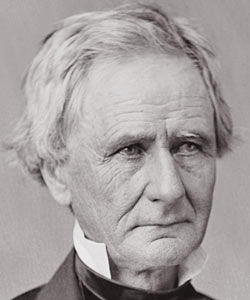
CAMERON, Simon, (father of James Donald Cameron), a Senator from Pennsylvania; born in Maytown, Lancaster County, Pa., March 8, 1799; apprenticed as a printer; newspaper owner and editor; cashier of a bank, president of two railroad companies, and adjutant general of Pennsylvania; elected to the United States Senate to fill the vacancy caused by the resignation of James Buchanan, and served from March 13, 1845, to March 3, 1849; elected as a Republican to the United States Senate and served from March 4, 1857, to March 4, 1861, when he resigned, having been appointed Secretary of War; chairman, Committee on Patents and the Patent Office (Twenty-ninth Congress), Committee on Public Buildings (Twenty-ninth Congress), Committee on District of Columbia (Twenty-ninth and Thirtieth Congresses), Committee on Printing (Thirtieth Congress); unsuccessful candidate for the Republican presidential nomination in 1860; Secretary of War in the Cabinet of President Abraham Lincoln 1861-1862; United States Minister to Russia 1862; was again elected as a Republican to the United States Senate in 1867; reelected in 1873, and served from March 4, 1867, until his resignation, effective March 12, 1877; chairman, Committee on Agriculture (Fortieth and Forty-first Congresses), Committee on Foreign Relations (Forty-second through Forty-fifth Congresses), Committee on Public Buildings and Grounds (Forty-second Congress); retired from active business pursuits and traveled extensively in Europe and the West Indies; died near Maytown, Lancaster County, Pa., June 26, 1889; interment in Harrisburg Cemetery, Harrisburg, Pa.
"Cameron, Simon," Biographical Directory of the United States Congress, 1774 to Present, http://bioguide.congress.gov/scripts/biodisplay.pl?index=C000068.
Simon Cameron (American National Biography)
Scholarship
In 1856 Cameron joined the Republican party, which absorbed many Know Nothings, and that year John Frémont, the first presidential candidate of the new party, briefly favored him for vice president. In 1857 Cameron returned to the U.S. Senate after a campaign that Thaddeus Stevens likened to "wholesale private bribery." Charges of bribing voters were too vague for official action, although a brief investigation was conducted. Despite his unsavory reputation, through hard work and the use of his personal contacts Cameron emerged as an important national leader of the Republicans and one of the party's national strategists. In the Senate he opposed the English Bill, which would have admitted Kansas immediately if the territory accepted the proslavery Lecompton constitution and a reduced land grant. He was best known for his active lobbying for tariffs protecting his state's coal and iron interests.
Jean Baker, "Cameron, Simon," American National Biography Online, February 2000, http://www.anb.org/articles/04/04-00195.html.