Record Data
Transcription
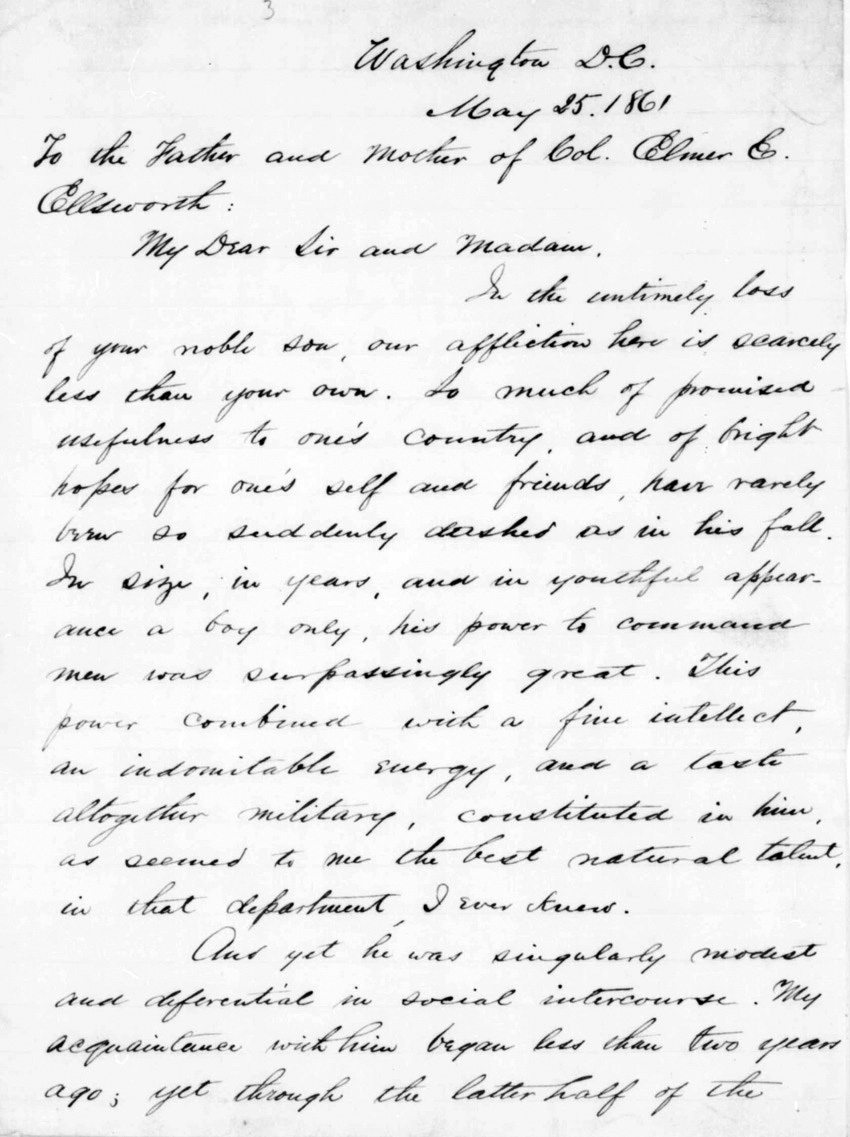
Washington D. C.
May 25. 1861
My Dear Sir and Madam.
In the untimely loss of your noble son, our affliction here is scarcely less than your own. So much of promised usefulness to one's country, and of bright hopes for one's self and friends, have rarely been so suddenly dashed as in his fall. In size, in years, and in youthful appearance a boy only, his power to command men was surpassingly great. This power combined with a fine intellect, an indomitable energy, and a taste altogether military, constituted in him, as seemed to me the best natural talent, in that department, I ever knew.
And yet he was singularly modest and deferential in social intercourse. My acquaintance with him began less than two years ago; yet through the latter half of the intervening period, it was as intimate as the disparity of our ages, and my engrossing engagements would permit. To me, he appeared to have no indulgences or pastimes; and I never heard him utter a profane or an intemperate word. What was conclusive of his good heart, he never forgot his parents. The honors he labored for so laudably, and in the sad end so gallantly gave his life, he meant for them, no less than for himself. In the hope that it may be no intrusion upon the sacredness of your sorrow, I have ventured to address you this tribute to the memory of my young friend, and your brave and early-fallen child.
May God give you that consolation which is beyond all earthly power.
Sincerely your friend
in a common affliction.
A. Lincoln