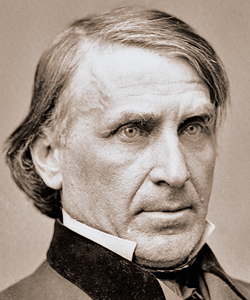
Elihu Benjamin Washburne (Congressional Biographical Directory)
Reference
WASHBURNE, Elihu Benjamin, (brother of Israel Washburn, Jr., Cadwallader Colden Washburn, and William Drew Washburn), a Representative from Illinois; born in Livermore, Androscoggin County, Maine, September 23, 1816; attended the common schools; printer’s apprentice; assistant editor of the Kennebec Journal, Augusta; studied law at Kents’ Hill Seminary in 1836 and at Harvard Law School in 1839; was admitted to the bar in 1840; moved to Galena, Jo Daviess County, Ill., in 1840 and commenced the practice of law; delegate to the Whig National Conventions in 1844 and 1852; unsuccessful candidate for election in 1848 to the Thirty-first Congress; elected as a Whig to the Thirty-third Congress and reelected as a Republican to the eight succeeding Congresses and served from March 4, 1853, to March 6, 1869, when he resigned; chairman, Committee on Commerce (Thirty-fourth and Thirty-sixth through Fortieth Congresses), Committee on Appropriations (Fortieth Congress); appointed as Secretary of State in the Cabinet of President Grant, but resigned a few days afterward to accept a diplomatic mission to France; upon the declaration of the Franco-Prussian War he protected with the American flag the Paris legations of the various German states; remained in Paris during the siege and was the only foreign minister who continued at his post during the days of the Commune; protected not only Germans but all the foreigners left by their ministers; served as Minister until 1877, when he returned and settled in Chicago, Ill.; engaged in literary pursuits; died in Chicago, Ill., October 23, 1887; interment in Greenwood Cemetery, Galena, Ill.
“Washburne, Elihu Benjamin,” Biographical Directory of the United States Congress, 1774 to Present, http://bioguide.congress.gov/scripts/biodisplay.pl?index=W000176.
Elihu Benjamin Washburne (American National Biography)
Scholarship
When [Abraham] Lincoln secretly arrived in Washington for the inauguration, [Elihu] Washburne was the only person who met him at the railroad station. His friendship with Lincoln enhanced his power during the war. When the war began, Washburne met Ulysses S. Grant, then a clerk in a Galena leather store but the only West Point graduate in Washburne's congressional district. Through Washburne's seniority and influence with Lincoln, Grant was appointed a brigadier general before encountering an enemy in the field. Washburne became Grant's political patron, defending him against all criticism and advocating his advancement in rank. Washburne's support proved valuable in 1862 when Grant received condemnation for failing to prepare for Confederate attack at Shiloh. In 1864 Washburne assured Lincoln that Grant would not become a presidential candidate if appointed general in chief. Though when Grant achieved victory in 1865, the hero of Appomattox no longer needed Washburne's patronage or his advice, the two maintained a close personal friendship. A member of the Joint Committee on Reconstruction, Washburne sided with the radicals and bitterly denounced President Andrew Johnson's Reconstruction policy while Grant, as army commander, worked within the administration but eventually broke with Johnson and accepted the Republican nomination for president in 1868.
John Y. Simon, "Washburne, Elihu Benjamin," American National Biography Online, February 2000, http://www.anb.org/articles/04/04-01038.html.